OrdiHand-GS: Ordinal-Guided Tracking and Hand-Refined Gaussian Avatars for Digital Signers
arXiv preprint
Abstract
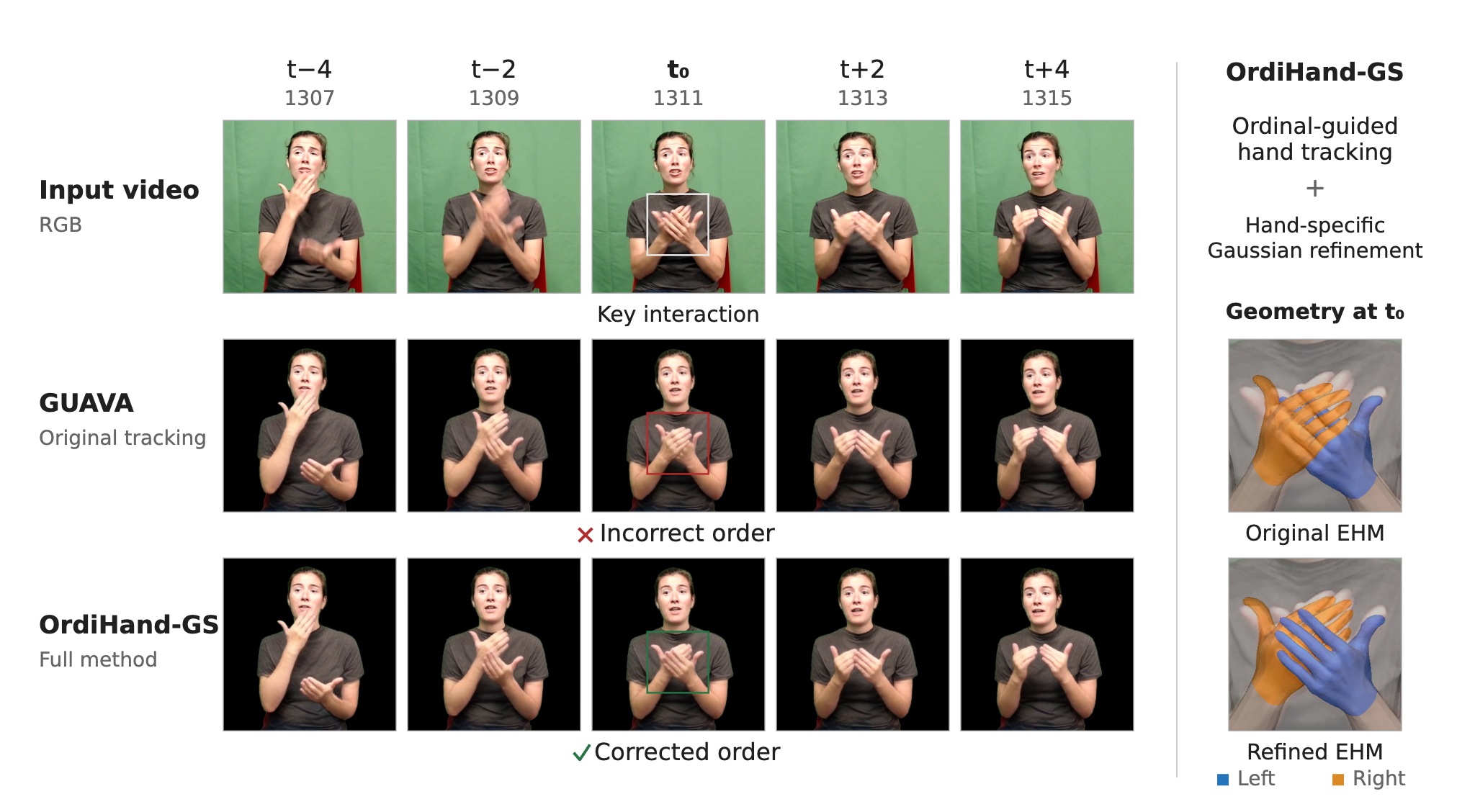
Digital signers, also known as signing avatars, convey sign language through animated virtual humans, where visual fidelity and linguistic intelligibility hinge primarily on the hands. When one hand crosses over the other, two failure modes dominate. First, monocular expressive-human tracking suffers from ordinal depth ambiguity: either hand can satisfy the same 2D landmarks, and the baseline tracker orders wrists at chance level on 365 annotated overlapping frames from How2Sign. Second, hand appearance remains blurred in neural rendering even after geometry is corrected.
We propose OrdiHand-GS to address these errors separately. Relative depth from a video depth estimator and apparent hand size vote, with confidence weighting and abstention, for a front–back relation, which enters expressive-human tracking as a hinge on median hand-surface depth. A source-conditioned residual head then refines the local positions of hand-associated UV Gaussians with the avatar backbone and renderer frozen. We instantiate the framework with GUAVA. Against matched unconstrained refinement, wrist-order accuracy rises from 32.9% to 77.3% at a cost of 0.39 pixels of reprojection error, while a random-sign placebo gives no balanced-accuracy gain. A 2×2 factorial evaluation attributes most of the interaction-rendering improvement to tracking-stage refinement, with a smaller additional benefit from the residual.
Method Overview
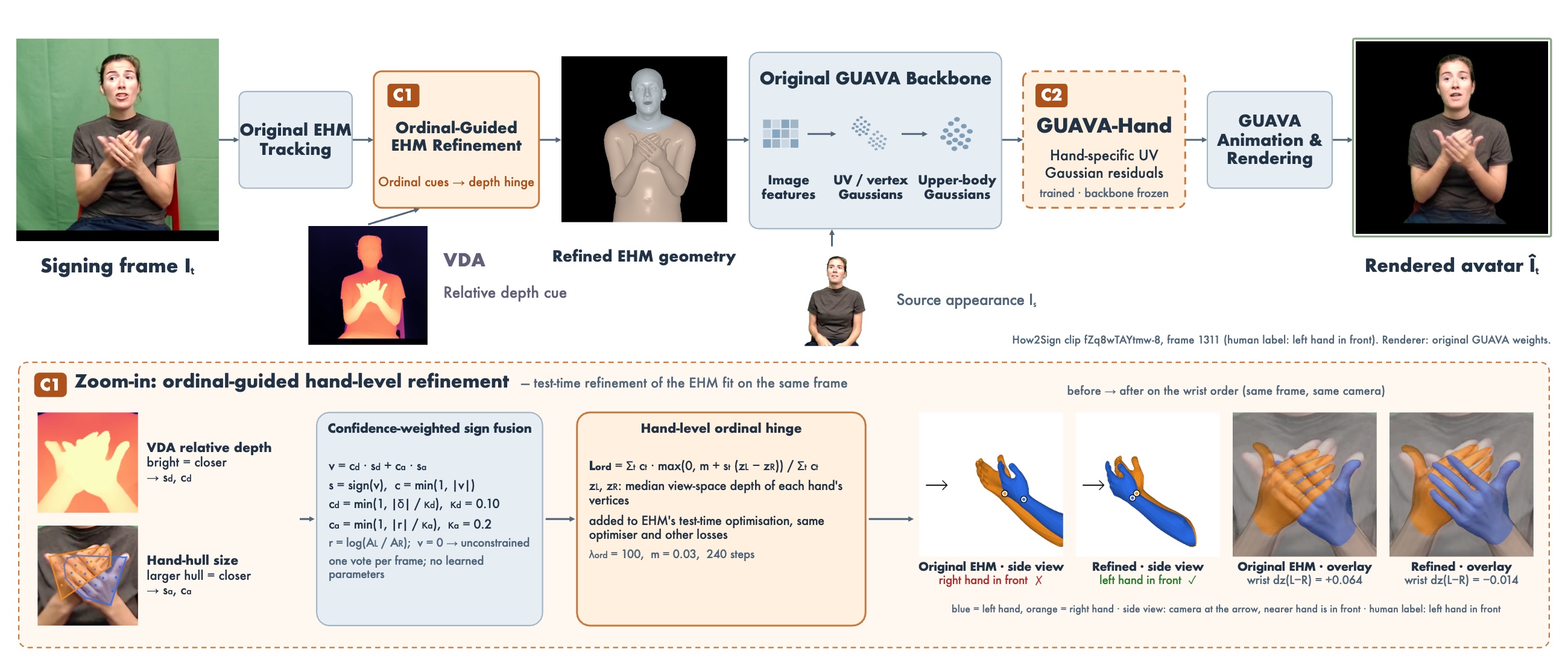
Ordinal-guided EHM refinement
Relative depth and apparent hand size are fused by a confidence-weighted vote with abstention, and the resulting sign is imposed through a hand-level depth hinge while resuming expressive-human tracking. The constraint has no learned parameters.Hand-specific UV Gaussian residuals
An ownership-gated, source-conditioned residual head refines the local positions of hand-associated UV Gaussians with the avatar backbone and renderer frozen, improving hand rendering on both original and refined tracking.Controlled evaluation
365 human-annotated overlapping-hand frames from 171 How2Sign clips, evaluated with a matched-budget control, a random-sign placebo, overlap stratification and a 2×2 factorial rendering study.Results
Wrist order on 365 annotated How2Sign frames
| Tracking arm | Accuracy (%) | Balanced acc. (%) | Δ acc. vs. control | Corrected | New errors |
|---|---|---|---|---|---|
| Original EHM | 33.4 [28.1, 39.1] | 49.8 [46.4, 52.7] | — | — | — |
| Matched control | 32.9 [27.5, 38.3] | 48.9 [45.5, 52.0] | 0 | — | — |
| Random-sign placebo | 42.2 [37.2, 47.6] | 48.6 [43.5, 53.7] | +9.3 [3.7, 15.0] | 71 | 37 |
| VDA hinge only | 67.1 [62.2, 71.7] | 67.4 [61.9, 72.5] | +34.2 [27.0, 41.3] | 156 | 31 |
| Area hinge only | 73.7 [68.4, 78.4] | 74.9 [69.5, 79.9] | +40.8 [33.6, 47.9] | 174 | 25 |
| Fused (OrdiHand-GS) | 77.3 [72.1, 81.5] | 76.9 [71.5, 81.7] | +44.4 [36.9, 51.6] | 184 | 22 |
95% clip-clustered bootstrap intervals in brackets. All arms resume the same original EHM fit with the same optimizer, seed, frames and budget. Randomizing the signs raises raw accuracy but leaves balanced accuracy at chance, so the gain comes from the sign information rather than from constraining itself.
Factorial rendering evaluation (interaction crop, 365 frames)
| Arm | Fused tracking | Hand residual | LPIPS ↓ | SSIM ↑ | PSNR ↑ | L1 ↓ |
|---|---|---|---|---|---|---|
| C0 (GUAVA) | – | – | 0.3174 | 0.7055 | 16.91 | 0.0897 |
| C1 | yes | – | 0.3065 | 0.7146 | 17.35 | 0.0865 |
| C2 | – | yes | 0.3155 | 0.7092 | 17.07 | 0.0881 |
| C3 (OrdiHand-GS) | yes | yes | 0.3047 | 0.7185 | 17.50 | 0.0851 |
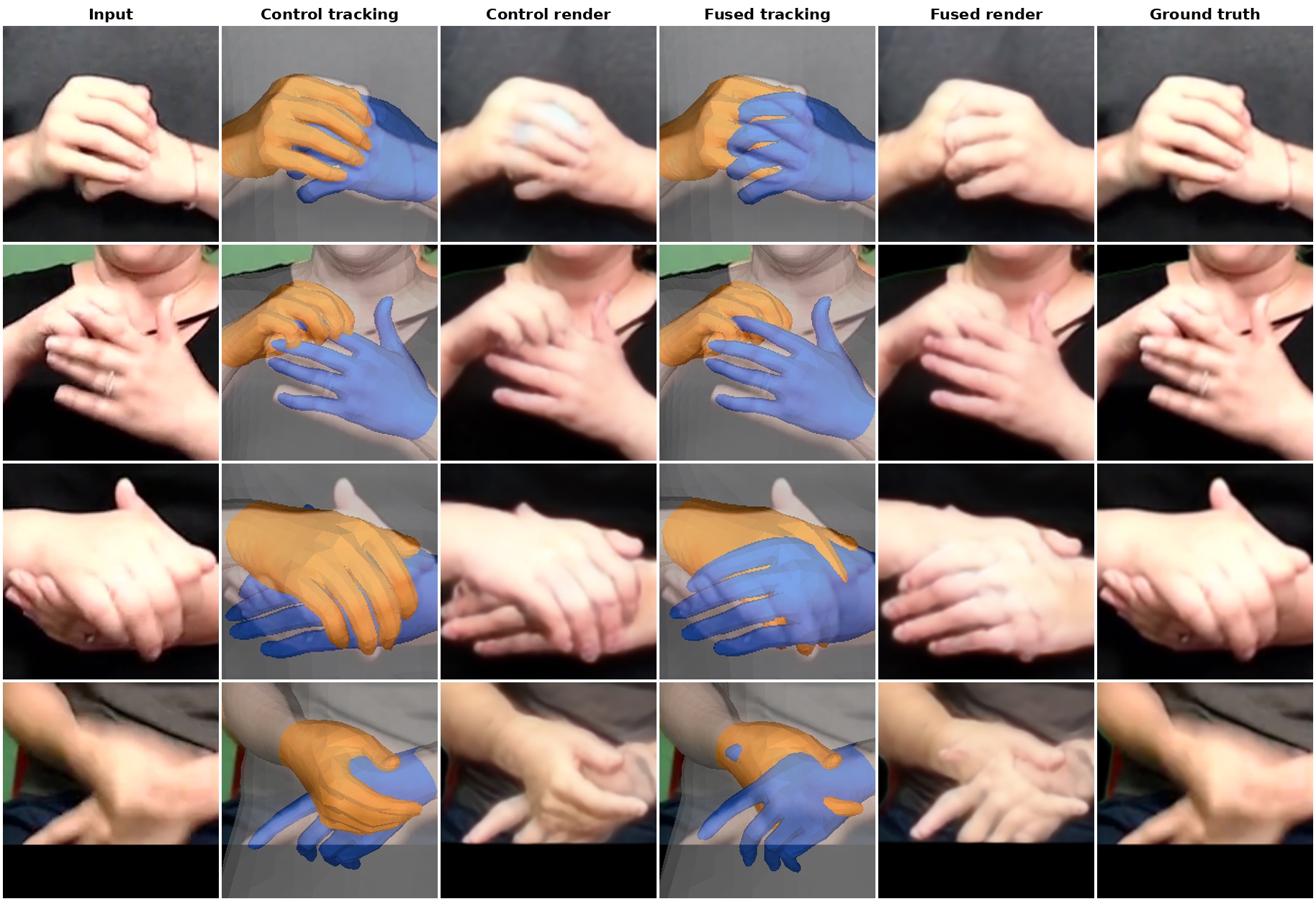
Most of the interaction-rendering gain comes from the tracking stage (C1 vs. C0); the hand residual adds a smaller, consistent improvement on either tracking. The two effects are close to additive, so no synergy is claimed.
Comparison with monocular avatar methods
| Full frame | Interaction crop | Hand crops | |||
|---|---|---|---|---|---|
| Method | LPIPS ↓ | LPIPS ↓ | SSIM ↑ | PSNR ↑ | LPIPS ↓ |
| EVA | 0.0940 | 0.3237 | 0.6942 | 16.51 | 0.3467 |
| ExAvatar | 0.1145 | 0.3510 | 0.6873 | 16.08 | 0.3793 |
| GaussianAvatar† | 0.1058 | 0.3435 | 0.6686 | 15.26 | 0.3641 |
| SplattingAvatar‡ | 0.1252 | 0.3627 | 0.6825 | 17.35 | 0.3822 |
| GUAVA | 0.0986 | 0.3190 | 0.7064 | 16.95 | 0.3454 |
| OrdiHand-GS | 0.0977 | 0.3026 | 0.7209 | 17.60 | 0.3236 |
127 annotated frames from 60 How2Sign clips. Per-subject methods are fitted to 140 frames of each clip; GUAVA and OrdiHand-GS use one reference image. † SMPL-X adapted, stage 1. ‡ SMPL-X mesh. Per-subject methods lead on the full frame; OrdiHand-GS is best on every interaction and hand metric, although its PSNR gains over SplattingAvatar are not statistically significant.
Qualitative Results
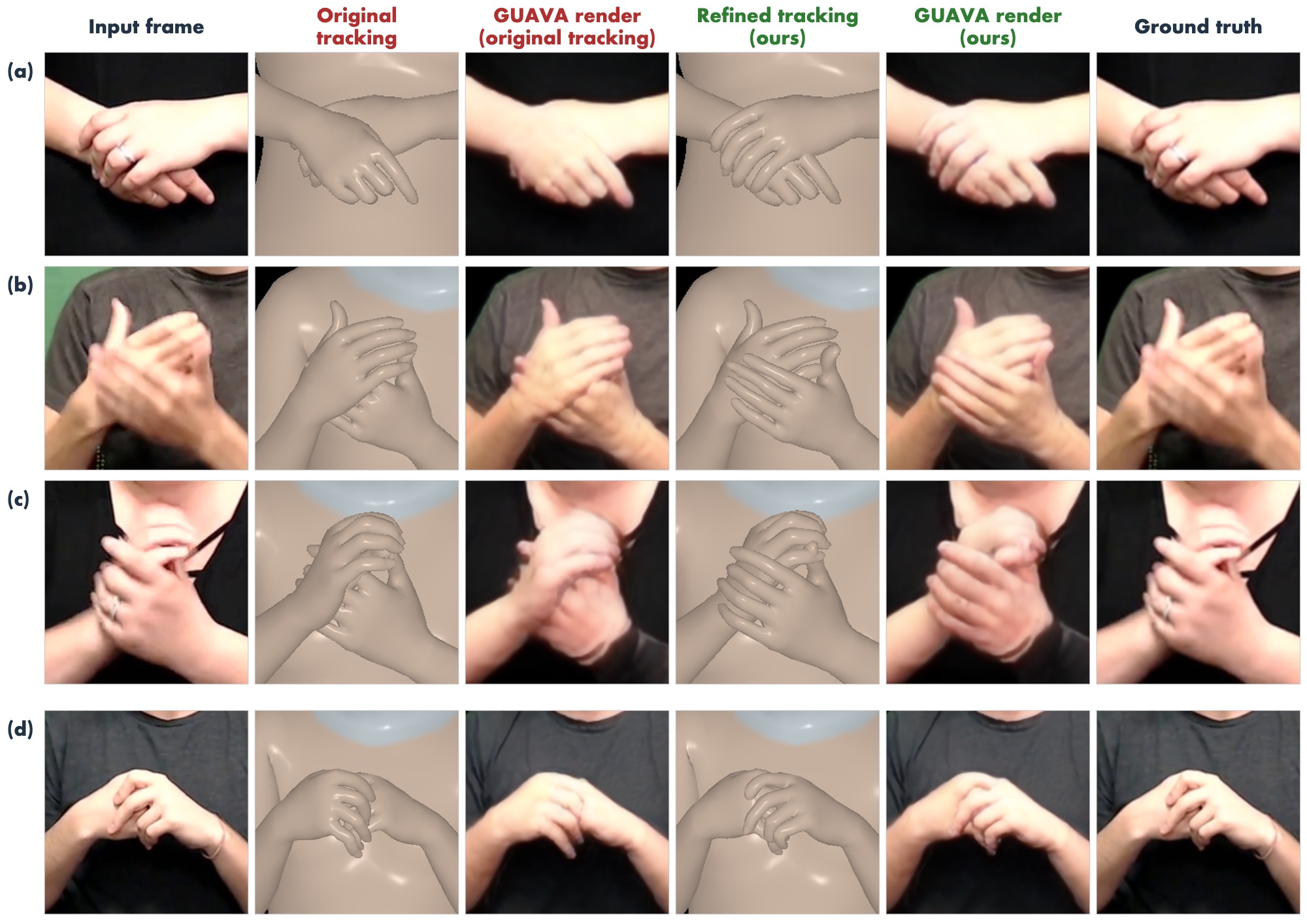
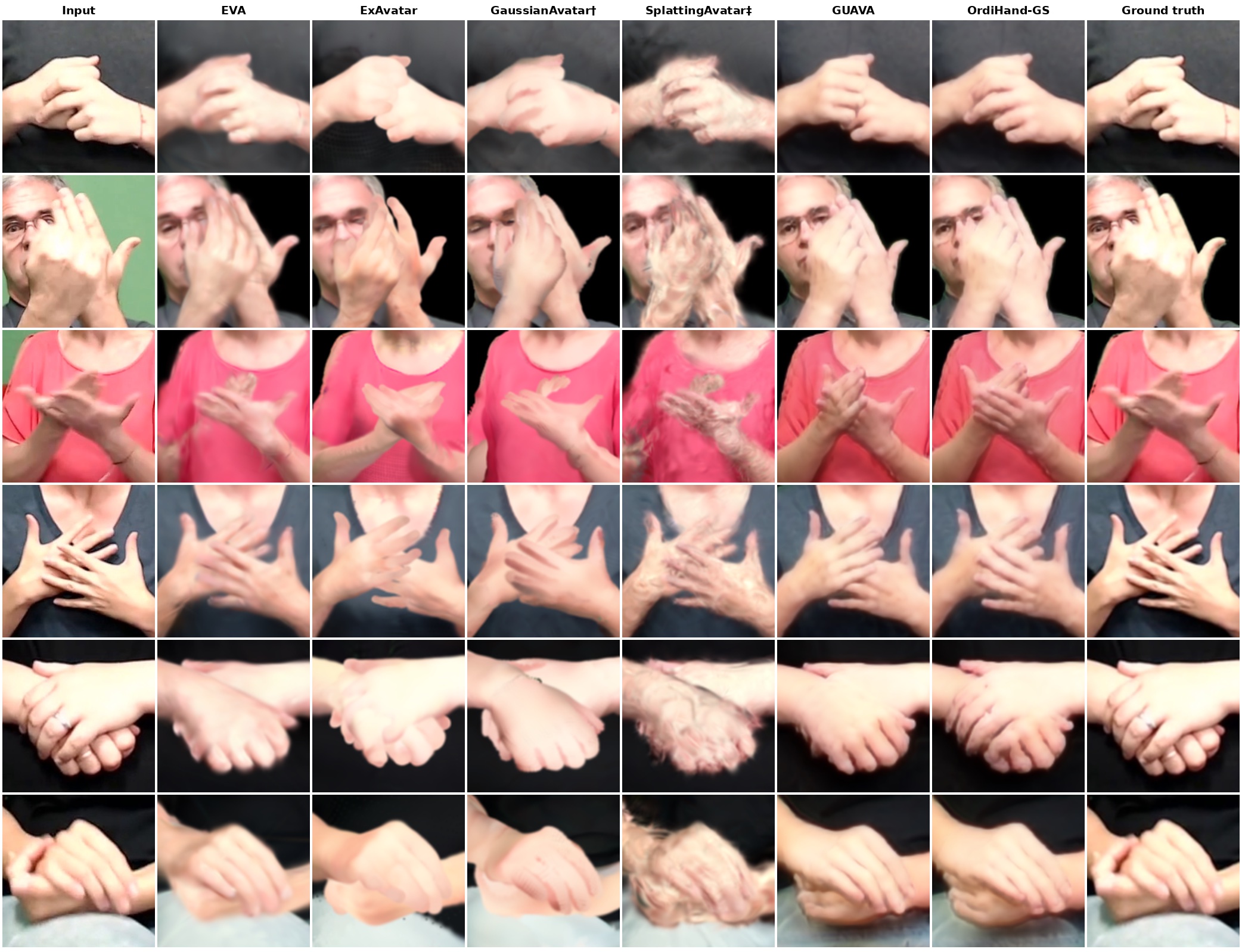
Video
All panels come from the fits, renders and checkpoints evaluated in the paper: weights are frozen and no optimization is run against any test frame. Fused tracking exists only on nine-frame windows around annotated frames, so moving segments are such windows played at 0.25× speed.
Limitations
- Ordinal cues can be wrong. Relative to the matched control, fused refinement introduces 22 new ordering errors; in 21 of them at least one cue votes for the wrong hand.
- The median hand-surface constraint orders the hands as a whole; it does not resolve finger-level interleaving or contact.
- Refined tracking and rendering are evaluated on labeled interaction frames within short windows, which does not establish full-video stability.
- Training and evaluation are video-disjoint rather than signer-disjoint, within one avatar backbone; sign intelligibility for signing users is not evaluated.
Acknowledgements
R. Zuo was supported by EPSRC Project GNOMON (EP/X011364/1) and Turing AI Fellowship (EP/Z534699/1). The authors acknowledge the use of resources provided by the Isambard-AI National AI Research Resource (AIRR). Isambard-AI is operated by the University of Bristol and is funded by the UK Government’s Department for Science, Innovation and Technology (DSIT) via UK Research and Innovation; and the Science and Technology Facilities Council [ST/AIRR/I-A-I/1023].